
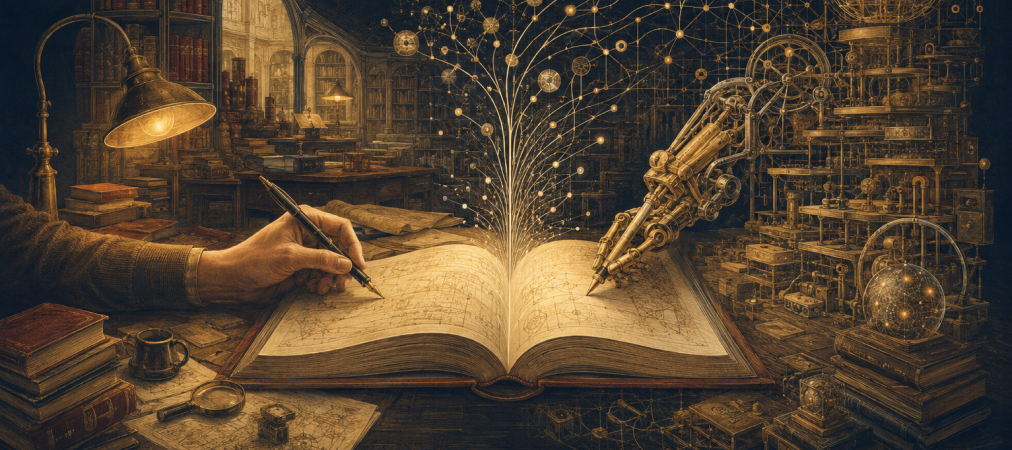
When I tell people I wrote a book with an artificial intelligence, the reactions tend to fall into two camps. Some assume I simply asked a chatbot to write a manuscript and put my name on the cover. Others worry that I've surrendered something fundamentally human—that creativity itself has become automated.
Neither is true.
The experience taught me something both more surprising and more important: artificial intelligence is neither an author nor merely a tool. It is something new—a collaborator that forces us to think more carefully about what creativity actually is. Every technology that has expanded human expression has initially been viewed with suspicion. The printing press threatened scribes. Photography threatened painting. Calculators threatened mathematics. Search engines threatened memory. Each innovation prompted fears that human capability would diminish. Instead, our capabilities evolved.
Artificial intelligence represents another such moment. Large language models can draft text, generate ideas, identify patterns, summarize research, and challenge assumptions with astonishing speed. What they cannot do is decide what matters. They cannot determine which questions deserve asking, which stories deserve telling, or which values should guide the work.
Those remain profoundly human responsibilities. Writing with AI is less like hiring a ghostwriter than working with an exceptionally well-read research assistant who never sleeps. It can propose possibilities I might never have considered. It can reveal weaknesses in an argument, suggest alternative structures, and surface perspectives drawn from vast bodies of knowledge.
But every meaningful decision remains my own. Which ideas belong in the book? Which arguments deserve emphasis? Which examples illuminate rather than distract? What moral conclusions should readers draw? Those choices cannot be outsourced.
Indeed, the more capable AI becomes, the more important human judgment becomes. The temptation will be to mistake fluency for wisdom. Artificial intelligence can produce convincing prose in seconds, but it possesses no lived experience. It has never loved, grieved, celebrated, or sacrificed. It does not understand courage because it has never been afraid. It cannot write from conviction because it holds none.
Those limitations matter. Readers are not ultimately searching for perfectly arranged sentences. They are searching for insight—evidence that another human being has wrestled honestly with difficult questions and emerged with something worth sharing.
Artificial intelligence can accelerate that process. It cannot replace it. Writing with AI also taught me something unexpected about humility.
Every draft becomes a conversation. Every assumption can be challenged. Every sentence can be reconsidered. Rather than diminishing authorship, this process often sharpens it, forcing the writer to become more intentional about every decision that survives to the final page. The question, then, is not whether AI will write books.
It already does. The more important question is whether humans will continue to contribute what machines cannot: judgment, curiosity, moral imagination, lived experience, and the willingness to stand behind every word they choose to publish. Artificial intelligence may change how books are written, but it will not change why we write them.


