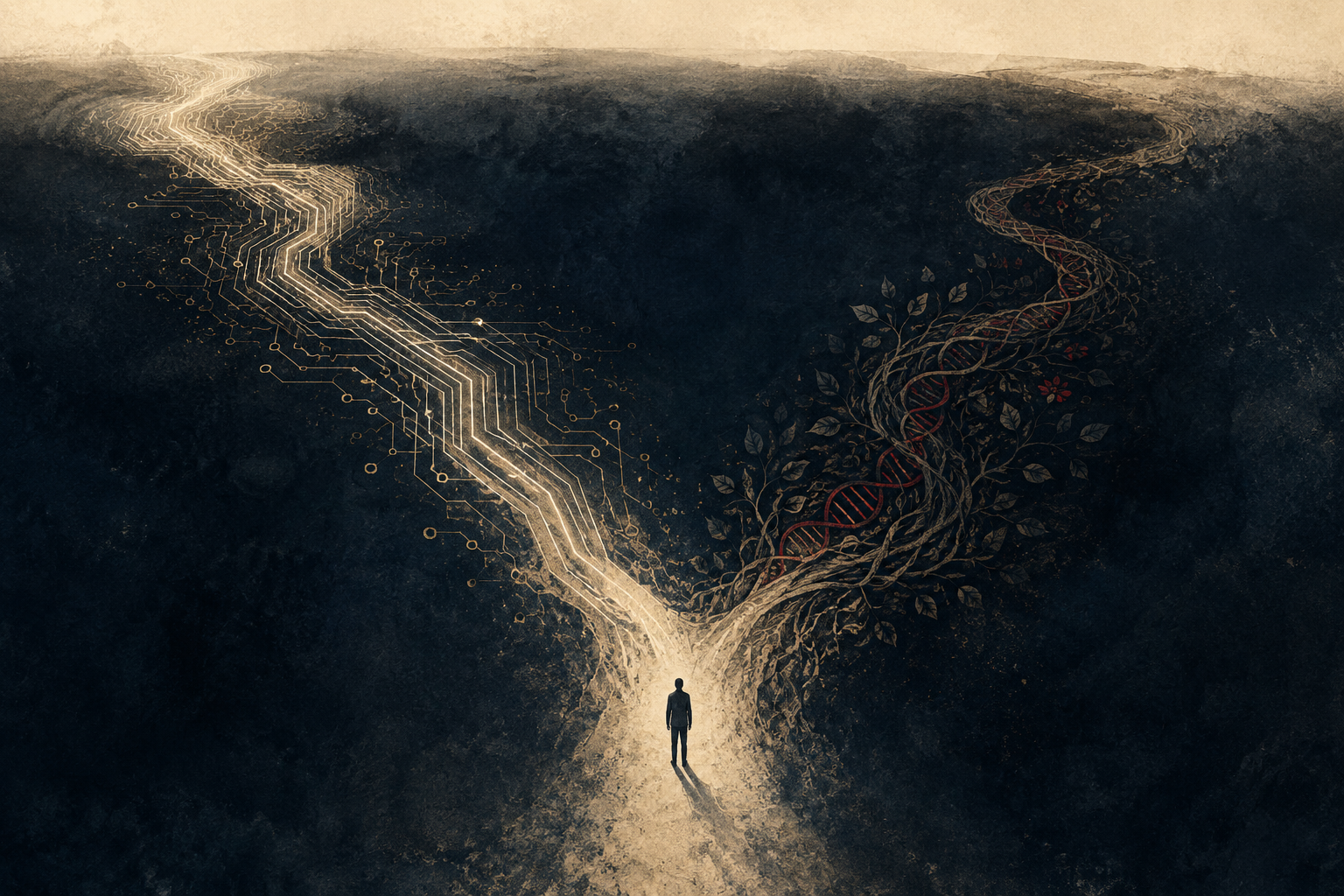
The question arriving now at the center of civilizational life is not whether artificial intelligence will transform the world. It will. The question is whether human beings will remember, amid the transformation, what they are for.
This is not a technological question. It is a philosophical one — perhaps the oldest kind. Every major disruption in history, from the printing press to the industrial revolution to the internet, has provoked some version of the same anxiety: Will there be a place for us? The answer has always been yes, but never in the way anyone predicted. The displaced handloom weaver did not become a factory worker who was then replaced by another machine; he became part of a civilization slowly, painfully, incompletely reordering its values. We are living through a version of that reordering now — faster, stranger, and with higher stakes than anything that came before.
Machines can write essays. They can compose music, generate images, diagnose tumors, and argue cases. What they cannot do — what they have never done — is mean anything by it. Meaning is not a computational output. It is what happens when a conscious being, aware of its own mortality, chooses to make something, love someone, or stand for a principle at personal cost. A language model does not experience the sentence it produces. It does not know what it is like to be afraid, or astonished, or bereft. It has never stood before a piece of music and felt the particular silence that follows when the last note dies.
This is not a sentimental argument. It is a precise one. The history of human meaning is a history of irreducible interiority — the fact that consciousness, from the inside, is something that no external process fully captures. For thousands of years, we have found purpose through exactly those things that resist quantification: love, grief, devotion, humor, wonder, sacrifice, moral seriousness. Artificial intelligence may out-perform us at tasks. It will not out-suffer us. And suffering — the conscious encounter with loss, limitation, and finitude — is where meaning is most deeply forged.
Meaning is not a computational output. It is what happens when a conscious being, aware of its own mortality, chooses to make something, love someone, or stand for a principle at personal cost.
Creativity presents a more complex case, because AI’s incursions here are genuinely provocative. When a machine can produce in seconds what once took years of craft to develop, something real is unsettled. But it is worth asking what, exactly, is being unsettled. Technical proficiency was never the heart of great art. The poem that endures is not the one with the most elegant meter; it is the one that makes you feel, obscurely and powerfully, that someone has said the thing you could not say. That requires a life lived. It requires the particular weight of a particular grief, the specific joy of a particular love, the embarrassment or courage or failure that belongs to one person and is offered, imperfectly, to many. AI can mimic the surface of expression. It cannot reproduce its source.
What will change — what is already changing — is the axis of human purpose. For generations, much of our identity has been tethered to productivity: what we make, what we earn, what we accomplish in the transactional sense. If machines absorb more of that labor, we may find ourselves returned, whether we wish it or not, to older questions. What does it mean to be a good person? How do we care for one another? What do we owe to the generations that follow? These are not new questions. They are, in some sense, the questions — the ones that every serious civilization has had to face and that industrial modernity allowed us, briefly and perhaps disastrously, to defer.
The challenge ahead is not primarily technical. It is moral and psychological. It will require us to resist the seduction of pure efficiency — the logic that says whatever a machine can do better, it should do — and to insist instead on the value of things that are not reducible to performance. Teaching is one of them. Caregiving is another. So is friendship, civic engagement, the practice of philosophy, the cultivation of moral seriousness, the willingness to sit with someone in their difficulty and offer not an answer but a presence.
Intelligence — raw, computational, optimized intelligence — is not the summit of human virtue. It is one faculty among many, and not always the most important one.
The most important thing to understand about this moment is that intelligence — raw, computational, optimized intelligence — is not the summit of human virtue. It is one faculty among many, and not always the most important one. Compassion requires no algorithm. Courage cannot be downloaded. Integrity, in the deepest sense, is not a capability. It is a commitment, renewed daily, against pressure and temptation, by a being who knows the cost.
The machines are coming for the work. They will not find, waiting on the other side of it, anything they can take.
AI will automate tasks, jobs, and productivity — the work we do. But when you strip all of that away, what’s left is the essentially human: love, grief, conscience, courage, wonder, moral seriousness. Those things are not takeable. They don’t exist in a form that can be optimized, replicated, or replaced.
They can have the tasks. They cannot have us.