Over long centuries, doctors have been educated by their patients to observe the prescription ritual. Most people seem to feel their complaints are not taken seriously unless they are in possession of a little slip of paper with indecipherable but magic markings. To the patient, a prescription is a certificate of assured recovery.
The doctor knows that it is the prescription slip itself, even more than what is written on it, that is often the vital ingredient for enabling a patient to get rid of whatever is ailing him. Drugs are not always necessary. Belief in recovery always is.
This strange-sounding word placebo is pointing medical science straight in the direction of something akin to a revolution in the theory and practice of medicine. The study of the placebo is opening up vast areas of knowledge about the way the body heals itself and the mysterious ability of the brain to order biochemical changes that are essential for combating disease.
Drugs are not always necessary. Belief in recovery always is.
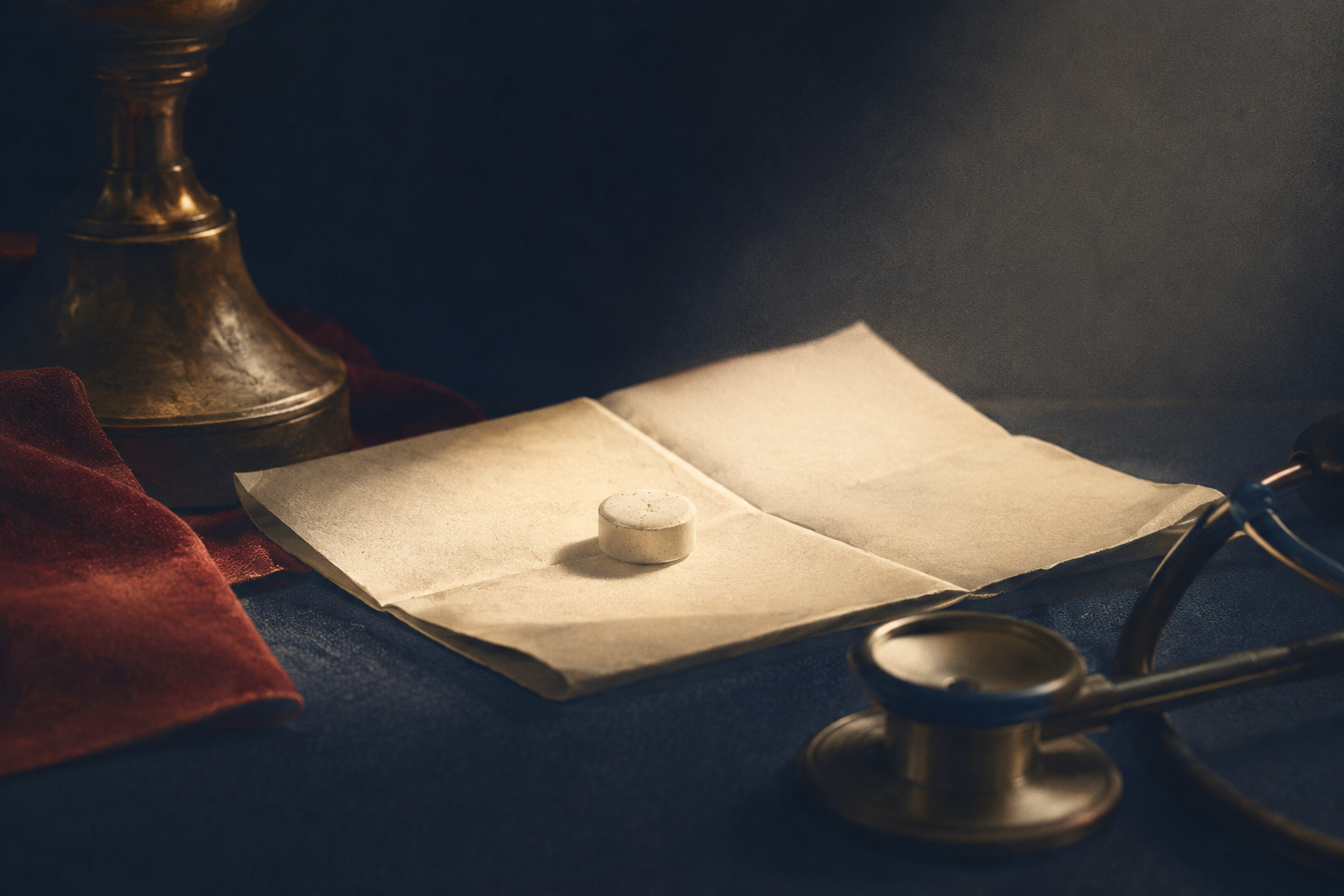
The word placebo comes from the Latin verb meaning “to please.” A placebo in the classical sense is an imitation medicine—generally an innocuous milk-sugar tablet dressed up like an authentic pill — given more for the purpose of placating a patient than for meeting a clearly diagnosed organic need.
Today, however, the once lowly placebo is receiving serious attention from medical scholars. Medical investigators such as Dr. Arthur K. Shapiro, the late Dr. Henry K. Beecher, Dr. Stewart Wolf, and Dr. Louis Lasagna have found substantial evidence showing that the placebo not only can be made to look like a powerful medication but can actually act like a medication — an authentic therapeutic agent for altering body chemistry and for helping to mobilize the body’s defenses in combating disorder or disease.
While the way the placebo works inside the body is still not completely understood, some placebo researchers theorize that it activates the cerebral cortex, which in turn switches on the endocrine system in general and the adrenal glands in particular. Whatever the precise pathways through the mind and body, enough evidence already exists to indicate that placebos can be as potent as — and sometimes more potent than — the active drugs they replace.
“Placebos can have profound effects on organic illnesses, including incurable cancer malignancies.” — Dr. Arthur K. Shapiro
There is almost no drug that does not have some side effects. And the more vaunted the prescription — antibiotics, cortisone, tranquilizers, anti-hypertensive compounds, anti-inflammatory agents, muscle relaxers — the greater the problem of adverse side effects.
A striking example of the doctor’s role in making a placebo work can be seen in an experiment where patients with bleeding ulcers were divided into two groups. Members of the first group were told by the doctor that a new drug had just been developed that would undoubtedly produce relief. The second group was told by nurses that a new experimental drug would be administered, but little was known about its effects. Seventy percent of the people in the first group received significant relief from their ulcers. Only 25 percent of the patients in the second group experienced similar benefit. Both groups had been given the identical “drug"—a placebo.
In the absence of a strong relationship between doctor and patient, the use of placebos may have little point or prospect. In this sense, the doctor himself is the most powerful placebo of all.
Some people are more susceptible to placebo therapy than others. It used to be assumed that there was some correlation between high suggestibility and low intelligence. This theory was exploded by Dr. H. Gold at the Cornell Conference on Therapy in 1946. The higher the intelligence, said Dr. Gold on the basis of his extended studies, the greater the potential benefit from the use of placebos.
The most prevalent — and, for all we know, most serious — health problem of our time is stress. The war against microbes has been largely won, but the struggle for equanimity is being lost. It is not just the congestion outside us — a congestion of people and ideas and issues — but our inner congestion that is hurting us.
It is doubtful whether the placebo — or any drug for that matter — would get very far without a patient’s robust will to live. For the will to live is a window on the future. It opens the individual to such help as the outside world has to offer, and it connects that help to the body’s own capability for fighting disease.
The placebo is only a tangible object made essential in an age that feels uncomfortable with intangibles, an age that prefers to think that every inner effect must have an outer cause.
When I asked Dr. Schweitzer how he accounted for the fact that anyone could possibly expect to become well after having been treated by a witch doctor, he said that I was asking him to divulge a secret that doctors have carried around inside them ever since Hippocrates.
“But I’ll tell you anyway,” he said, his face illuminated by that half-smile. “The witch doctor succeeds for the same reason all the rest of us succeed. Each patient carries his own doctor inside him. They come to us not knowing that truth. We are at our best when we give the doctor who resides within each patient a chance to go to work.”
The placebo is the doctor who resides within.