PLACEHOLDER — NOT READY FOR PUBLICATION.
For centuries, humanity has measured progress by the libraries it built. The Library of Alexandria sought to collect the knowledge of the ancient world under one roof. Medieval monasteries preserved manuscripts that might otherwise have vanished. Universities organized disciplines into separate departments, and the internet connected billions of documents across the globe.
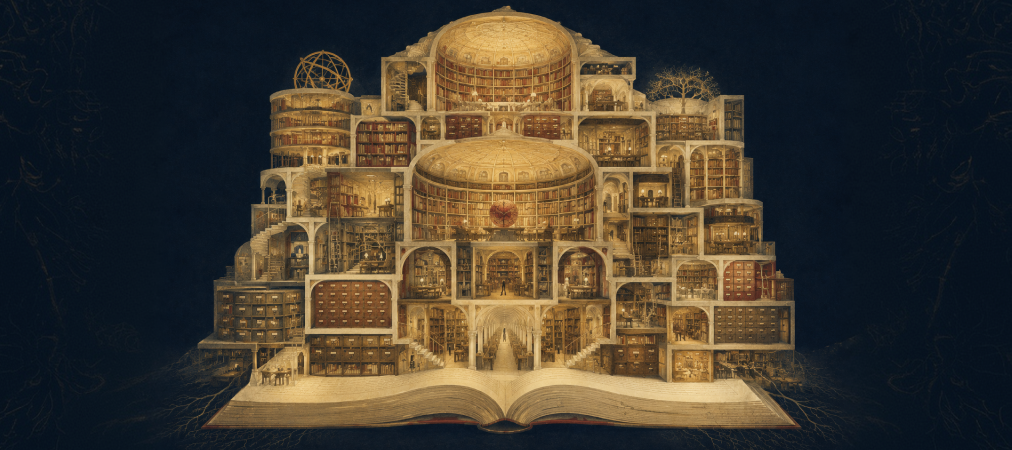
Today, we stand on the threshold of another transformation. For the first time in history, artificial intelligence offers the possibility not simply of storing information, but of understanding relationships among ideas at a scale no individual—or institution—could ever achieve. Instead of searching millions of disconnected books, articles, databases, and archives, we may soon build something far more ambitious: a library of libraries.
Imagine a system that connects medical research from Boston with agricultural discoveries in Kenya, climate data from Antarctica with engineering breakthroughs in Tokyo, and centuries-old philosophical texts with the latest advances in artificial intelligence. Rather than organizing knowledge into isolated silos, it would reveal the hidden connections that drive discovery.
That shift matters because humanity's greatest challenges no longer fit neatly within academic departments. Climate change is an environmental issue, an engineering problem, an economic question, and a geopolitical challenge. Cancer is simultaneously a biological, computational, ethical, and social problem. Artificial intelligence itself draws from computer science, neuroscience, psychology, philosophy, and law.
Progress increasingly happens at the intersections. Yet our institutions remain organized around specialization. Universities reward expertise within disciplines. Research is published in highly specialized journals. Valuable insights often remain trapped inside professional communities that rarely speak to one another.
Artificial intelligence has the potential to become a bridge. Rather than replacing human expertise, it can help connect experts who might otherwise never recognize that they are working on different aspects of the same problem. It can surface patterns across enormous bodies of literature, identify overlooked relationships, and accelerate the exchange of ideas across disciplines. Knowledge becomes more powerful when it becomes more connected.
That does not mean every answer should come from an algorithm. Human judgment remains essential. AI can identify correlations; people determine which questions are worth asking and which discoveries deserve action. The goal is not to build an artificial mind that replaces human intelligence. It is to construct an intellectual infrastructure that allows billions of human minds to collaborate more effectively than ever before. In that sense, the library of libraries is less a technological project than a civilizational one.
Every generation inherits the accumulated knowledge of those who came before it. Our responsibility is not merely to preserve that inheritance but to make it more accessible, more interconnected, and more useful for those who follow. The greatest discoveries of the twenty-first century may not come from finding entirely new information. They may come from finally seeing how the knowledge we already possess fits together.